
Bitcoin Miner Survival Threshold: Plummeting Transaction Fees and Soaring Costs, What Lies Ahead?

Original Article Title: "Bitcoin Miners' Survival Line: Plunging Transaction Fees and Soaring Costs, What Lies Ahead?"
Original Article Author: Alvis, Mars Finance
Bitcoin is now at a real risk of being "done for" without a new ecological hotspot. Miners' survival pressure has reached its limit, with transaction fees plummeting and costs skyrocketing, causing many small miners to consider shutting down. Once miners start to exit, hash rates decrease, block generation slows down, and the network's security is threatened. Moreover, in a situation of price instability, without new ecological developments to drive demand growth, Bitcoin will fall into a downward spiral.
Income Squeeze: Miners' Profits Face Multiple Pressures
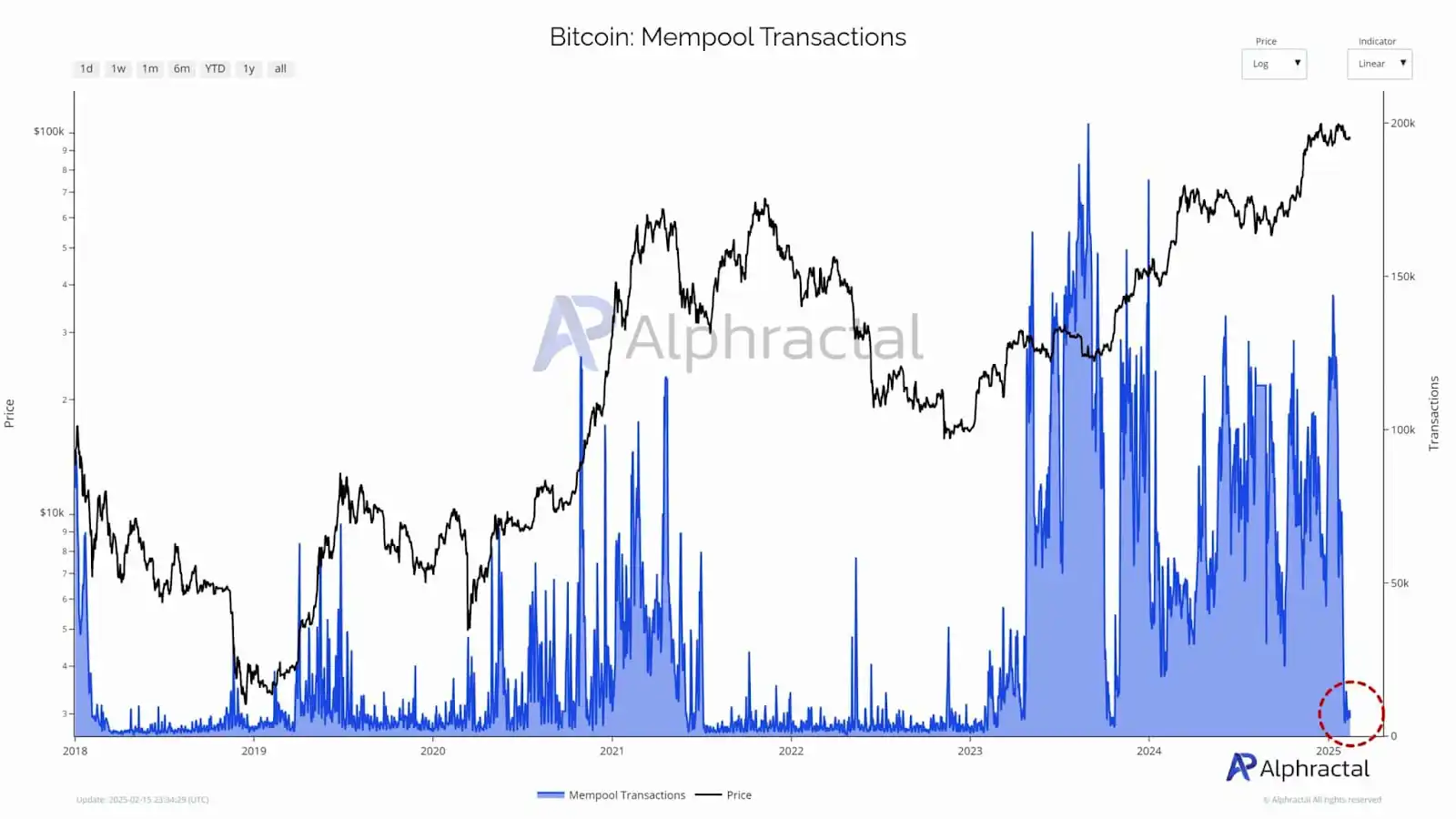
The profitability of Bitcoin mining has significantly deteriorated, with several key indicators showing a weakening profit potential. Firstly, the unconfirmed transactions in the Bitcoin memory pool have dropped to a multi-year low, indicating reduced network demand, directly impacting miners' transaction fee income. Historically, a decrease in transaction activity has often led to a bear market, which, although not necessarily implying a price drop, may suggest structural changes in the network.
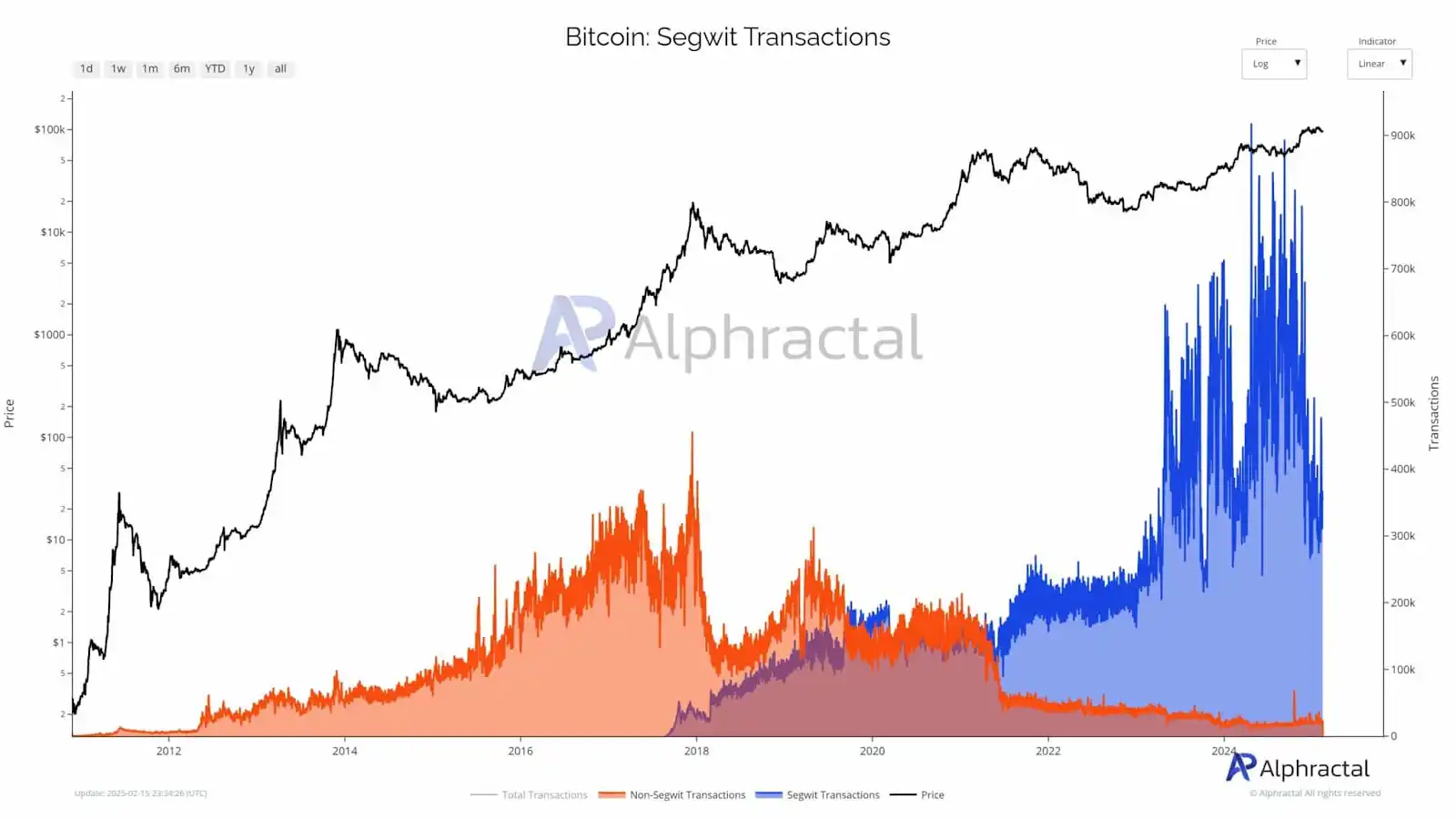
Furthermore, the gradual decline of SegWit transaction types has reduced network efficiency, further increasing block space requirements, squeezing miners' income potential. Despite the rise in Bitcoin prices, the downward trend in revenue highlights the impact of rising network difficulty and intensified competition.
Industry Consolidation Accelerates: Small Miners Face Exit Risk
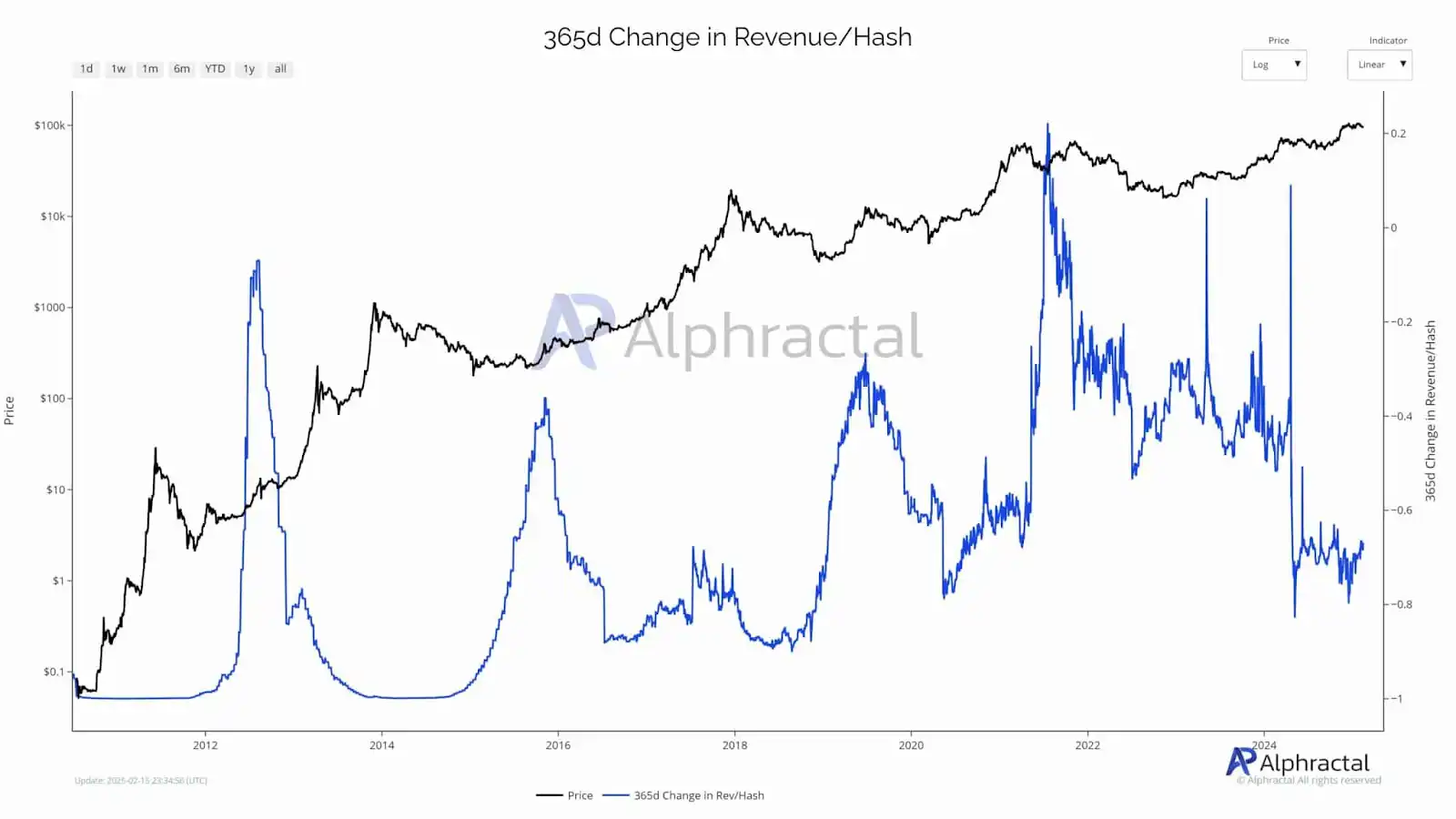
A key miner indicator, revenue/hash rate, is at a historical low, with diminishing returns indicating that rising network difficulty and intensified competition are eroding profitability.
With the block reward halving, particularly small miners are facing survival pressure. Decreased profitability and reduced transaction fee income put small enterprises at risk of exiting the market, accelerating industry consolidation. In the future, only well-capitalized, technologically advanced large miners will be able to maintain competitiveness, leading to increased market concentration.
Network Difficulty Increases: Rising Costs Force Miners to Seek Survival Strategies
Bitcoin network difficulty has hit a new high, putting miners under greater cost pressure. With rising energy and hardware costs, especially for small miners with outdated equipment, survival pressure intensifies. Some miners are turning to low-cost, sustainable energy sources, such as hydroelectric or geothermal power, while some mining companies are seeking breakthroughs through diversified income sources or mergers and acquisitions.
This trend may accelerate the centralization of the industry, where the most well-capitalized and efficient miners will take the lead, impacting Bitcoin's decentralized nature. In the future, changes in miners' geographic distribution and mining security practices may raise concerns about network security.
Market Rebalancing: Increased Industry Threshold
As operating costs continue to rise, inefficient miners will be eliminated, leading to a natural industry "rebalancing." This change may further promote industry centralization, where only large-scale miners can survive in fierce competition, solidifying Bitcoin mining as a high-threshold industry.
However, market centralization also raises questions about Bitcoin's decentralized ethos. The reduction of dominant miners could concentrate network security in the hands of a few miners, potentially affecting the network's long-term stability and resistance to censorship.
Impact on Bitcoin
In the short term, Bitcoin miners face dual pressure from declining transaction fees and rising costs, which may cause small miners to exit the market, leading to a decrease in network hashrate and tightening Bitcoin supply. The compression of miner revenue may affect market confidence in Bitcoin, causing short-term price volatility and possibly threatening the network's decentralization, introducing security risks.
In the long run, with technological innovation and optimized energy costs, miners may regain some profitability, lower operating costs, helping alleviate profit pressures and stabilize the market. While there may be short-term downward price risks, with sustained demand growth and tightened supply, Bitcoin prices may trend upward in the long term, especially as market demand for Bitcoin steadily increases.
Bitcoin currently urgently needs a new ecosystem, clearly more than just speculative trading of "buying the dip." It needs more use cases, smart contracts, decentralized applications, and even a brand-new financial system to support it.
If Bitcoin lacks a strong enough ecosystem, once miners cannot maintain profitability, the entire network's operation will become challenging, and market trust in Bitcoin will be shaken. Miner exodus could be a "crisis" in Bitcoin's future outlook, while ecosystem development flourishing is the key to Bitcoin's survival.
Disclaimer: This article does not constitute investment advice. Users should consider whether any opinions, views, or conclusions in this article are suitable for their specific circumstances and comply with relevant laws and regulations in their country or region.
You may also like

Morning Report | CoinEx becomes a key hub for Iran to evade sanctions, involving over $3.8 billion in funds; Kalshi seeks a new round of financing, with a valuation potentially rising to $40 billion

Why do cryptocurrency projects always like to change their names?

From the white-haired stock god to the billionaire fund mogul, the smart people shorting Nvidia are all getting rich using the same framework

Morning News | The draft amendment to the People's Bank of China Law aims to clarify the legal status of digital renminbi; South Korea will transfer about 40 unregistered virtual asset service providers to law enforcement agencies

The cryptocurrency industry has entered the "Show Me" era: merely relying on vision is no longer enough
Interpreting the Ethereum Foundation's new structure: Reaffirming self-sovereignty amid institutional trends
Former SpaceX engineer reconstructs the financial execution system using first principles

Tidal Investment: We still have a positive outlook on the AI industry chain, but the reasons have changed

Standard Chartered Bank sings a 50x rhapsody again, aiming for AAVE to reach 3500 USD

The interim executive director of the Ethereum Foundation speaks out: What is our mission?
Why does OKX want to start a new company with the parent company of the New York Stock Exchange?

Why Is PAXG Price Different From Gold? 5 Reasons Crypto Traders Should Know

WEEX OpenAPI 101: 5 Powerful Modules, AI Trading Tools, and Grab Up to 70% Revenue Opportunities
Learn how WEEX OpenAPI connects traders, developers, AI agents, and trading platforms. Discover WEEX API features, Binance-compatible integration, automated trading workflows, revenue opportunities, and ecosystem possibilities.

Interview with NDV Founder Jason Huang: Popping the AI Bubble and the Myth of Microstrategy, Seeking the Ultimate Ace in the Crypto Market

Morning Report | Former Ethereum Foundation researcher establishes Ethlabs; EU Parliament Economic Committee passes digital euro regulatory proposal

Dragonfly partner Haseeb: The fastest-growing companies in the future may all be stuck at 149 people

How xBubble Breaks the Deadlock in VC's Heavy Investment in the OPC Economy

The encrypted unicorn Blockstream is deeply embroiled in a serious fraud case
Morning Report | CoinEx becomes a key hub for Iran to evade sanctions, involving over $3.8 billion in funds; Kalshi seeks a new round of financing, with a valuation potentially rising to $40 billion
Why do cryptocurrency projects always like to change their names?
From the white-haired stock god to the billionaire fund mogul, the smart people shorting Nvidia are all getting rich using the same framework
Morning News | The draft amendment to the People's Bank of China Law aims to clarify the legal status of digital renminbi; South Korea will transfer about 40 unregistered virtual asset service providers to law enforcement agencies
The cryptocurrency industry has entered the "Show Me" era: merely relying on vision is no longer enough
Interpreting the Ethereum Foundation's new structure: Reaffirming self-sovereignty amid institutional trends


